Adriana Marina
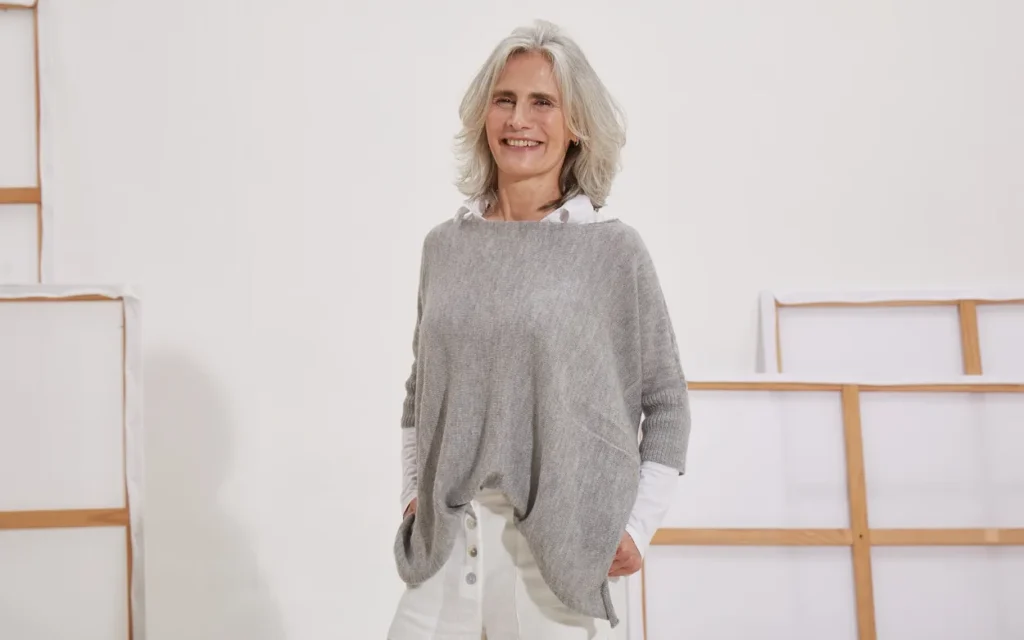
Adriana Marina built a trajectory in which fashion ceased to function solely as an aesthetic language and became a tool for economic, cultural, and environmental transformation. Her work brings together textile tradition, social justice, and sustainability, integrating Andean communities into a productive model that recognizes them as protagonists. Her path shows how a long-term vision can redefine an entire industry.
Patagonian origins and training that combined technique and sensitivity
Born in Santa Cruz, Adriana grew up in a territory where the relationship with nature is lived directly and daily. Fibers, manual crafts, and ancestral textile knowledge formed part of her early environment. Later she studied Systems and Economics, focusing on inequality and development. This background allowed her to clearly read the structural gaps faced by producing communities and to understand how the global fashion industry reproduced exclusionary circuits.
The creation of Animaná: a brand that returns value to its origin
With Animaná, Adriana proposed a model that integrates quality, ethics, and traceability. Her goal was to build a brand working with natural fibers—alpaca, llama, merino sheep, vicuña—respecting producing communities and reducing intermediaries. Each piece was meant to represent a fair relationship between territory, culture, and contemporary design. With this approach, the brand positioned itself as an alternative to mass fashion, prioritizing slow processes, noble materials, and transparent labor conditions.
A working logic with communities: collaboration, respect, and autonomy
Adriana’s work did not stop at garment production. She sought to strengthen local capacities, improve incomes, and recover techniques at risk of disappearing. The workshops and cooperatives involved in Animaná gained access to training, management tools, commercial spaces, and structures that allow their craft to move from informality to more sustainable models. This approach elevated the self-esteem of artisans and weavers, who ceased to be invisible suppliers and became cultural and economic agents.
Hecho por Nosotros: a platform intervening across the entire chain
Building on Animaná’s momentum, Adriana founded Hecho por Nosotros, an organization that expanded her work toward structural impact. This platform combines research, collaboration with international institutions, training, traceability standards, and policy development. Its goal is to transform the industry from within: to promote real transparency, reduce environmental impact, integrate ancestral knowledge into global supply chains, and create tools that guarantee fair trade. The initiative earned international recognition and helped position the Latin American model of ethical fashion in global forums.
Recognition as an Ashoka Fellow and international consolidation
Her selection as an Ashoka Fellow validated her vision as a proposal for systemic change. This recognition placed her work within the global map of social innovation, connecting her with other entrepreneurs and organizations seeking to redefine industries. She became a reference in debates on sustainability, circular economy, productive inclusion, and the transformation of global value chains.
A vision that integrates design, environment, and social justice
Adriana’s approach does not separate aesthetics from ethics. Her model understands that design can engage with communities without imposing external logics. She advocates for fashion built on transparent processes, free of extractive practices, and committed to environmental responsibility. Her work incorporated technological tools that allow consumers to know the origin, raw materials, producers, and labor conditions behind each piece.
Impact on communities and preservation of ancestral techniques
The model Adriana promoted helped recover textile techniques that were losing generational continuity. Through training, design labs, and collective structures, weavers modernized tools without losing identity. They also increased income, diversified products, and gained access to markets previously unreachable for small structures. This transformation strengthened regional economies often excluded from global circuits.
Challenges in a sector dominated by mass production
Implementing an ethical model in an industry built on massive scale brings constant tension. In the context of fast consumption and low prices, Adriana works to build a responsible public that understands the real value of a product made with noble fibers and fair processes. She also faces logistical challenges linked to rural production and the need to maintain quality standards without altering local identities.
Future projection: expansion and education for a different industry
Adriana’s work continues to grow. Her goal is to expand the network of communities, strengthen traceability mechanisms, promote applied research, and encourage education on conscious consumption. She also seeks to consolidate alliances between designers, universities, and international organizations so ethical fashion becomes a standard, not an exception.
A legacy that redefines the meaning of producing
The trajectory of Adriana Marina demonstrates that it is possible to build an industry where the beauty of a product is tied to respect for its makers and care for the environment. Her work shows that fashion can be a driver of inclusion, cultural dialogue, and sustainable development. Her legacy already serves as a reference for those seeking to connect territory, innovation, and social justice within a historically unequal production system.