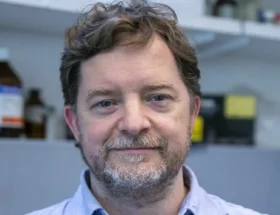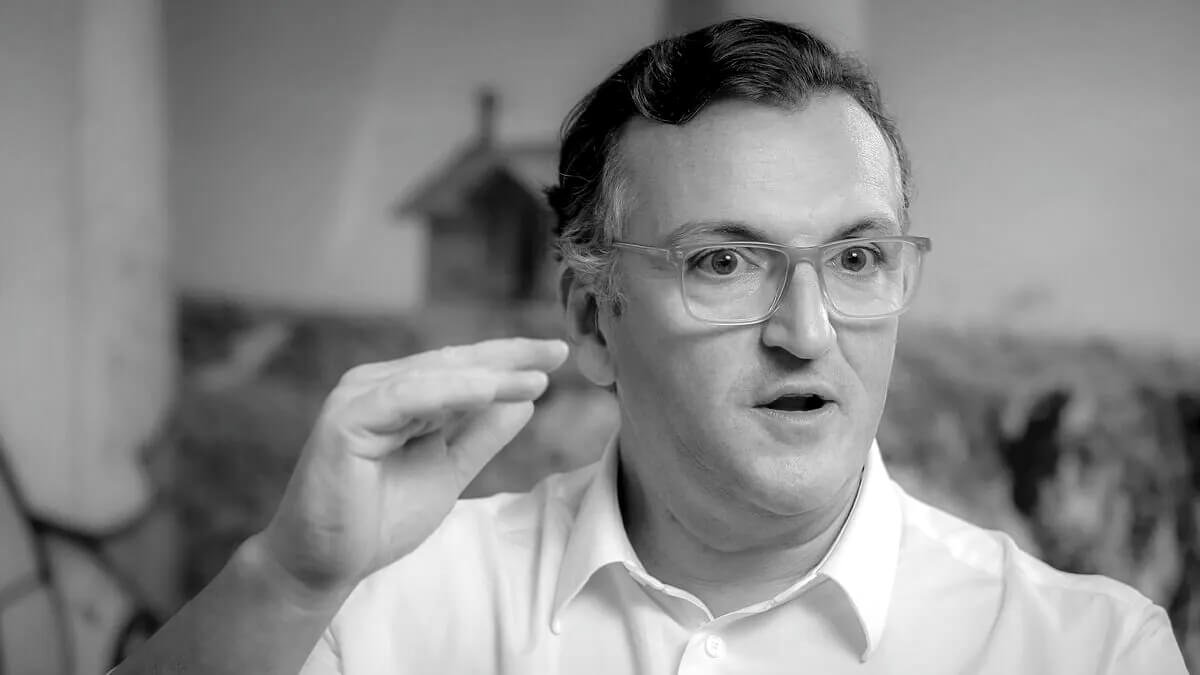
Diego Golombek

Diego Golombek built an uncommon path within Argentine science: researcher in chronobiology, university professor, laboratory director, editor, author and science communicator. His influence does not come from a traditional business position, but from a sustained ability to organize knowledge, train teams and turn complex scientific topics into accessible public culture.
An Argentine reference between science and communication
Diego Golombek occupies a singular place within Argentine science because his path is not limited to academic research. His figure brings together laboratory work, teaching, writing, television and cultural management. That combination allowed him to transform specialized topics, such as biological rhythms and sleep, into content understandable to broad audiences. His leadership appears in that ability to build bridges between technical knowledge and everyday life.
Academic training and a biological perspective
Golombek trained as a graduate and doctor in Biology at the University of Buenos Aires, one of the central institutions of Argentina’s scientific system. From that base, he developed a perspective oriented toward understanding how organisms regulate internal processes. Biology, in his case, was not only a laboratory discipline, but also a way of interpreting behaviors, habits, bodily cycles and links between environment, body and society.
Chronobiology as a field of work
His main specialty is chronobiology, the field that studies biological rhythms and the way the body organizes functions such as sleep, wakefulness, temperature, attention and hormonal activity. This field makes it possible to analyze everyday phenomena with scientific tools: why certain people perform better at different times, how artificial light affects the body or what impact night shifts have on health and performance.
Scientific direction and team building
As a senior researcher at CONICET and a university professor, Golombek developed work connected to laboratory direction, researcher training and knowledge production. Leading a laboratory means defining questions, coordinating teams, designing experiments, interpreting data and sustaining lines of work over time. There, a form of leadership appears based on method, continuity, academic judgment and the ability to organize scientific talent.
Science that reaches the public
One of the most recognizable features of his career is science communication. Golombek managed to explain complex topics without reducing them to empty formulas or losing conceptual precision. That task requires careful translation: selecting examples, organizing concepts, avoiding misleading simplifications and building a clear narrative. His contribution was to show that science can also be a cultural tool for thinking about health, education, rest and curiosity.
Editorial leadership and science books
His participation in editorial projects, especially in collections dedicated to science for broad audiences, strengthened his influence beyond the university sphere. A scientific editorial project requires more than publishing books: it needs selection criteria, identity, continuity, reliable authors and accessible language. In that field, Golombek acted as an organizer of knowledge, promoting texts capable of bringing scientific topics closer to non-specialized readers.
Television, media and public pedagogy
Golombek’s presence on television and in other media expanded his social reach. Audiovisual communication requires turning a scientific idea into a scene, question, experiment or short narrative. That passage is not minor: it forces one to think about how an audience learns when it is not necessarily looking for a formal class. His communication style allowed scientific questions to enter mass spaces without abandoning the seriousness of academic work.
Awards and institutional recognition
Throughout his career, Golombek received recognitions such as the Konex Award, the Platinum Konex, the UNESCO-Kalinga Prize, the Ig Nobel Prize and the Bernardo Houssay Award. These distinctions reflect different dimensions of his profile: research, creativity, public communication and contribution to the scientific system. His case shows how a researcher can acquire social influence when combining academic production, pedagogy and institutional capacity.
A vision of leadership applied to knowledge
Diego Golombek’s leadership does not respond to the classic model of the business CEO, but it does share a logic of strategic direction: detecting a field of value, organizing teams, building formats, expanding audiences and sustaining a public identity. His vision transformed chronobiology and science communication into spaces of social impact. That is where his main contribution lies: making science circulate, be understood and become part of common conversations.