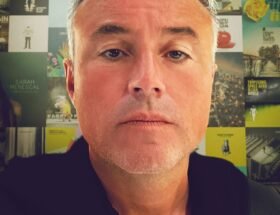
Federico Scialabba, la estrategia detrás de Music Brokers

Federico Scialabba, co-founder and CEO of Music Brokers, appears as a central figure in a record-industry operation that goes beyond the music news itself. Ansu Fati’s signing with the label makes it possible to observe how a multinational company founded in South America can transform a public biography, a private artistic search and a global audience into a musical career with professional structure.
A record label for unconventional careers
A record label does not only release songs. In its more complex dimension, it identifies trajectories, interprets audiences, structures creative projects and turns an artistic expression into a sustainable career. In Ansu Fati’s case, Music Brokers does not present the release as an occasional participation by a famous figure. It incorporates him through a long-term career agreement, a decision that implies planning, investment, continuity and the construction of a musical identity.
Scialabba appears in this process with a dual role. On one hand, he holds an executive position within Music Brokers, which involves leading business decisions, artistic development and distribution alliances. On the other hand, he participates in the production of the first single, “Sea Como Sea”, alongside Gambinoalaprod and Adrián Ayerbe. That creative involvement allows for a reading of an integrated form of leadership: the executive does not limit himself to approving an operation from a distance, but works at the point where the project acquires sound, direction and personality.
The signing of Ansu Fati also makes it possible to observe how the boundaries of the music industry are expanding. For decades, record labels worked mainly with artists who emerged from recognizable music scenes. Today, careers can be born in more hybrid areas, where sport, digital platforms, celebrity, cultural identity and music intersect. Fati arrives from European football, but his project does not rely solely on his sporting visibility. According to the available information, he began writing songs during the rehabilitation of his knee injury in 2020 and later consolidated that path in studio sessions.
Music Brokers takes that story and turns it into a professional structure. The company organizes the project through production, mastering, cover artwork, alternative versions and global distribution through The Orchard, linked to Sony Music. Each of those layers shows how a record label transforms a personal experience into an artistic product prepared to circulate internationally. The release does not depend only on Ansu Fati’s name, but on an industrial architecture that gives it form and reach.

The value of turning a biography into an artistic project
The case also speaks to a business reading of cultural value. The relationship between football and music is not new, but it usually appears under promotional formats: artists invited by clubs, shirt campaigns, songs associated with events or marketing actions. Here, the operation is different. A footballer from FC Barcelona’s own universe enters a record label as a formal artist. That difference turns the project into a catalog movement, not only a visibility action.
From a leadership perspective, the central point lies in Music Brokers’ ability to detect an opportunity where one might otherwise see an anomaly. Ansu Fati is not an artist who comes from the traditional music scene, but he has a public biography, a global audience, a story of recovery and a cultural identity shaped by Africa, Spain and European football. Scialabba and Music Brokers read that combination as artistic material. The record label does not create the artist’s story from scratch; it organizes it, produces it and projects it.
The release of “Sea Como Sea” therefore works as the first step in a broader strategy. If a musical career is measured by continuity, repertoire, identity and positioning, Music Brokers’ decision aims to build a path, not only to take advantage of a media moment. That is the business value of the case: showing how a record label can turn a known figure into an artist with structure, sound and a development plan.