Gustavo Mariani
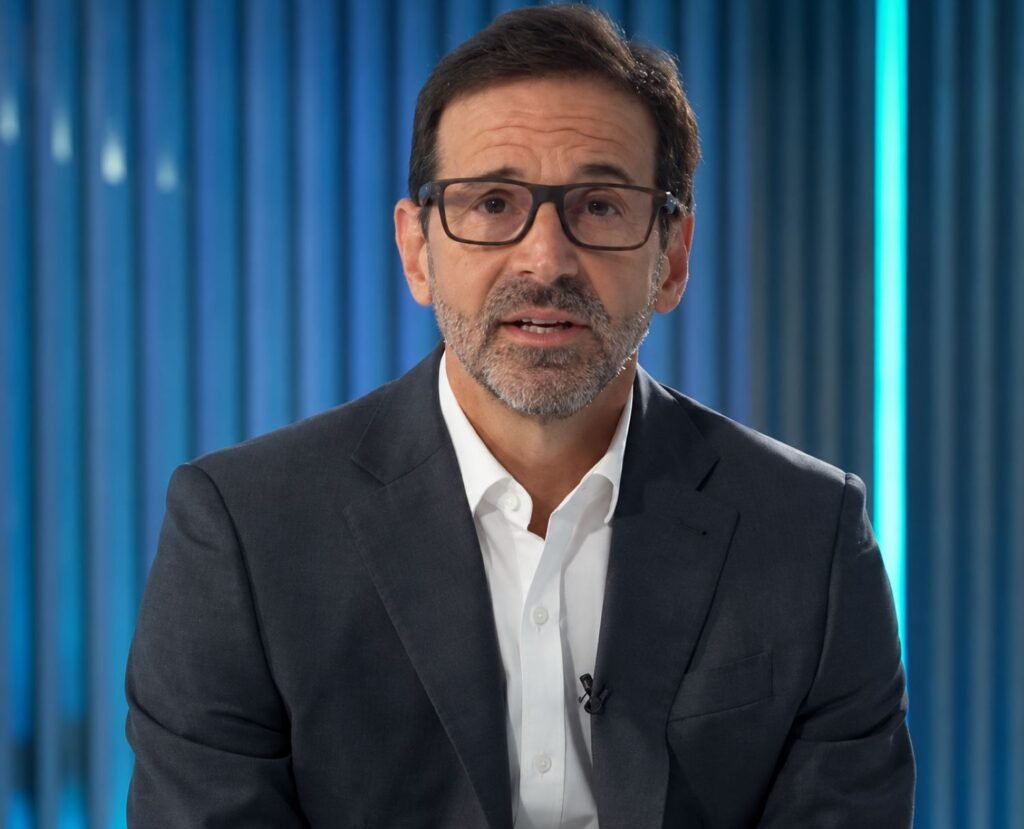
At the head of Argentina’s largest integrated energy company since 2018, the CEO accelerated a record investment of nearly US$1.1 billion in 2025 to move the company into unconventional oil production.
Gustavo Mariani has led the country’s largest integrated energy company since December 2018. He was born in Buenos Aires on September 9, 1970, attended secondary school at Colegio Ward in Ramos Mejía and graduated from the University of Belgrano with a degree in economics. Then came the specialization that would shape his profile: a master’s degree in finance from Universidad del CEMA and, in 1998, his designation as a Chartered Financial Analyst (CFA), the most demanding international certification in the profession. He was only the second Argentine to obtain it, long before the credential became a standard among local analysts.
From analyst at Grupo Dolphin to founding partner of Pampa
Mariani’s career began in 1993, when he joined Grupo EMES — then Grupo Dolphin — as an analyst, the investment company created by Marcelo Mindlin and his partners. He moved up quickly there: first as investment portfolio manager, then as managing partner in 2005. During those years, the group played a significant role in the growth of IRSA, Cresud and Alto Palermo, and between 2001 and 2003 Mariani served as chief financial officer of that real estate and agribusiness conglomerate.
The move into the energy business came with the purchase of assets that would later merge into a single company: co-control of Transener, management of Edenor, thermal power plants such as Güemes and Piedrabuena, and the Nihuiles and Diamante hydroelectric plants. In November 2005, Mariani signed, together with Marcelo Mindlin, Damián Mindlin and Ricardo Torres, the creation of Pampa Energía S.A. Four years later, the company debuted on the New York Stock Exchange.
Within that structure, Mariani was not a career executive hired from outside. He is one of the owners: he is part of the control group that retains around 20% of the share capital. Before taking over general management, he served as co-CEO until 2016 and as executive vice president until 2018.
How he reached the chief executive role
The leadership change was announced on December 18, 2018. Marcelo Mindlin left the general management role to focus on chairing the board, and Mariani became CEO and vice president. He was 48. One of his first moves was to add Pampa to ByMA’s Corporate Governance Panel, alongside YPF, the listing that brings together companies with transparency standards above those required by regulation.
His career also includes a less predictable chapter for a finance man: between 2011 and 2018, he was a director of King Agro, the carbon-fiber spray boom company for sprayers founded by his brothers Guillermo and Gabriel. The company signed an exclusivity agreement with John Deere, which acquired 100% of its capital in 2018.
Gustavo Mariani and the shift toward Vaca Muerta
For much of its history, Pampa carried the label of a gas and electricity company. Under Mariani’s leadership, that profile shifted its axis. “The company has a diversified business philosophy and now we are going to become oil producers,” the CEO said at La Nación’s Energy Summit in August 2025.
The numbers support that definition. That year, Pampa committed to a record investment of nearly US$1.1 billion, with between 70% and 80% directed to Rincón de Aranda, its unconventional oil area in Neuquén. The target set by Mariani: to reach 50,000 barrels per day by the end of 2026, with annual sales of about US$1.2 billion at the prices of that time. The company already ranks as the country’s fourth-largest gas producer — above 10% of the total — and leads power generation.
The plan relies on evacuation infrastructure. Pampa participates in the Vaca Muerta Sur pipeline, which will carry oil from the Neuquén Basin to the San Matías Gulf with capacity for 500,000 barrels per day, and is part of a liquefied gas consortium with Pan American Energy, Harbour and YPF, where it holds 20% and expects the first floating liquefaction vessels toward the end of 2027. As a shareholder of TGS, it is also pushing the expansion of the Perito Moreno gas pipeline, a project of around US$700 million that, according to the calculations Mariani gave, would save the country between US$500 million and US$600 million a year in imports.
The scale of the bet
The scale of the project became clear in mid-2026, when the Government approved a US$4.521 billion RIGI for Pampa Energía to expand its production in Vaca Muerta, according to La Nación. It is one of the largest adhesions to the incentive regime, and it ties the company’s near future to shale development. For Mariani, who began by measuring investment portfolios and now signs off on billion-dollar disbursements in the Neuquén formation, it is the largest move of a management period that has already lasted more than seven years.