Hernán Giardini

Leadership and trajectory in Greenpeace
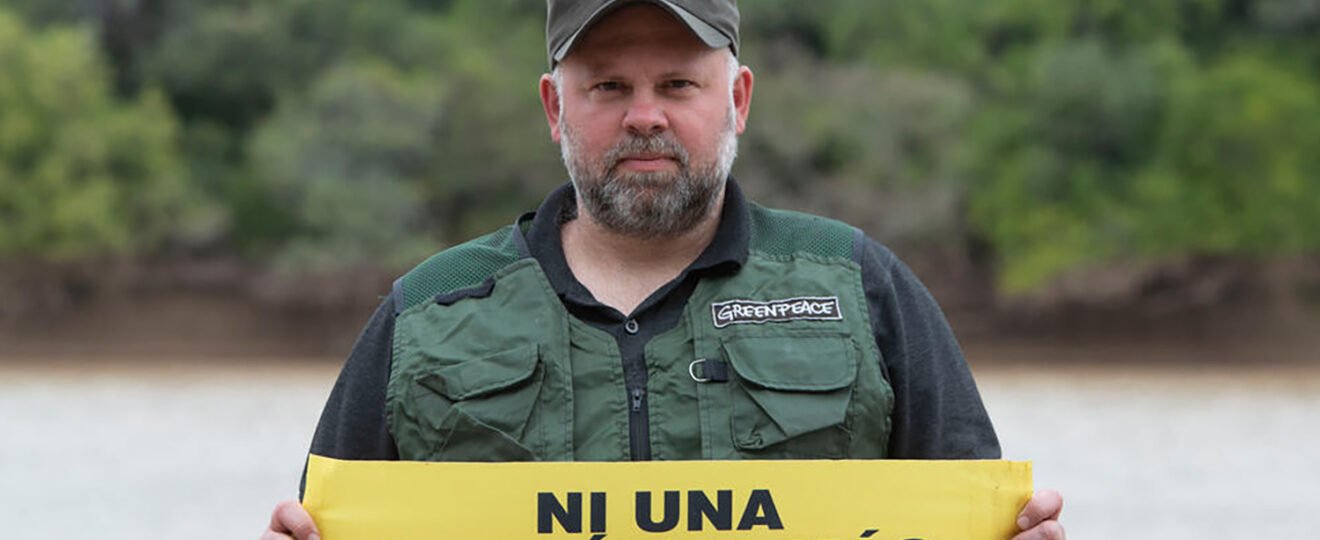
Hernán Giardini has established himself as an unavoidable reference in the management of high-impact campaigns in the Southern Cone. With two uninterrupted decades as Forest Campaign Coordinator at Greenpeace, his figure represents the professionalization of environmental activism. His role is not limited to denouncing problems; he acts as a political and communication strategist capable of bringing governments, corporations, legislators, and affected communities to the same discussion table.
With a degree in Communication Sciences from the University of Buenos Aires (UBA) and a background in journalism, Giardini integrated informational rigor with a vocation for social change from the outset of his career. Before leading the forest agenda within the international NGO, he built a solid background in working with social movements, recovered factories, and rural organizations. This early experience in crisis management and territorial negotiation shaped his current approach: a leadership model grounded in deep field knowledge and the construction of multisectoral alliances.
Results-driven management
Giardini’s effectiveness is reflected in tangible results and structural regulatory changes. He was the operational architect behind the approval of the National Forest Law in 2007, a turning point for Argentina’s environmental policy. His ability to coordinate teams and generate public pressure was demonstrated by solid metrics: he managed the publication of 175 media stories in national and provincial outlets in just 45 days, pushing the issue irreversibly onto the public agenda.
His strategic vision was also key in the Glacier Law (Law 26.639). In this process, Giardini led federal coordination and technical messaging, contributing to the gathering of 1.5 million signatures. The result was a groundbreaking regulation that established the Minimum Standards Regime, prohibiting extractive industrial activities—such as mining and hydrocarbons—in strategic freshwater reserves, a critical asset for the country’s future development.
Research, data and strategy
Under his coordination, the Greenpeace team has refined the use of hard data for political influence. Giardini oversees the creation of annual reports and satellite monitoring that expose an alarming reality: more than 50% of deforestation in Argentina is illegal. This information not only supports public communication but also substantiates high-profile legal actions.
A landmark example of his judicial approach was the complaint filed before the Supreme Court in 2019 for illegal clearing in Chiguayante. The action sought to make operational impunity visible and set legal precedents, demonstrating that his leadership spans from grassroots mobilization to strategic litigation in the highest judicial arenas.
His vision for the future and adaptability
From his operational base in Bariloche, Giardini analyzes the current scenario with a critical perspective on systemic risks. He identifies a complex context marked by a lack of political will and what he calls “post-pandemic individualism,” a factor that, in his assessment, has weakened the collective action needed to confront the climate crisis.
In the face of environmental deregulation in various provinces and pressure from reactionary sectors, his response is constant innovation. Giardini pushes his teams to “refresh” narratives and adapt communication strategies daily. His objective is clear: connect with new audiences and maintain the relevance of native forest protection, understanding that sustainability is not merely an ecological variable but a management imperative for the region’s future.