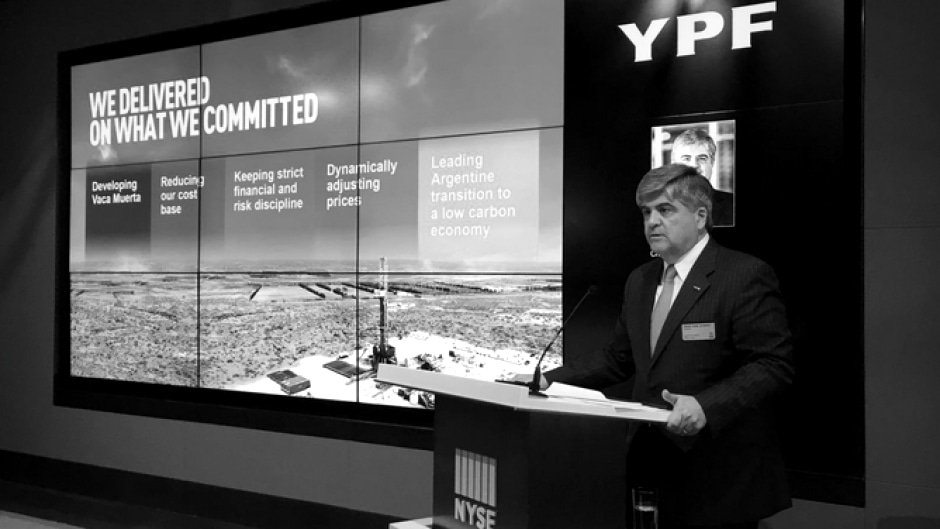
Juan José Aranguren

Juan José Aranguren
Juan José Aranguren built a career defined by technical management in the energy sector and by the application of business criteria in highly complex regulatory environments. His trajectory combines corporate leadership within a global company with direct responsibility in the design of public policies, positioning him as a key figure for analyzing the relationship between private management, the State, and Argentina’s energy system.
Education and Early Professional Years
Trained as a chemical engineer, Aranguren began his career in the energy industry during a period of transformation in Argentina’s oil sector. From early stages, he worked in technical and operational areas, developing in-depth knowledge of industrial processes, safety, logistics, and quality control. This technical foundation proved decisive for his later progression into leadership roles, where understanding the energy business had to be integrated with strategic decision-making and organizational leadership.
Leadership at Shell Argentina
His longest and most relevant period in the private sector took place as president of Shell Argentina. In that role, he led a complex structure embedded within a multinational corporation with strict global standards. Management required balancing head office demands, local regulations, and unstable macroeconomic conditions. Aranguren emphasized processes, planning, and risk control, consolidating a leadership style focused on operational predictability and regulatory compliance.
Management Under Restrictive Economic Conditions
During his corporate leadership, Argentina’s energy sector faced price controls, tariff distortions, and investment restrictions. Within this context, the strategy centered on sustaining operations, preserving critical assets, and ensuring safety and quality standards. This experience reinforced a vision focused on the need for clear and sustainable rules, a principle later reflected in his performance in public office.
Transition to the Ministry of Energy and Mining
In 2015, he assumed the role of minister, transferring his business experience to the State. The challenge involved managing a national energy system marked by severe tariff lag, high subsidies, and declining investment. From a technical perspective, he promoted the adjustment of relative prices and the gradual reduction of subsidies, aiming to restore economic signals within the sector and recover investment conditions over the medium term.
Management Approach and Controversies
His management style relied on technical diagnoses and economic criteria, with limited emphasis on traditional political communication. This characteristic generated resistance and intense public debate, particularly due to the social impact of tariff measures and his background in the private sector. The controversies highlighted the tensions that arise when a corporate profile takes decisions with significant social consequences within the State.
Business Vision Applied to the State
Aranguren introduced into the public agenda concepts drawn from energy management, such as real costs, financial sustainability, and regulatory predictability. His influence did not rest on building broad political consensus, but on forcing a structural debate about the viability of Argentina’s energy system. This approach left lessons on the scope and limits of transferring private management models to public policy.
Profile and Impact
Juan José Aranguren’s career allows for an examination of a form of technical leadership that prioritizes processes, rules, and long-term planning. His experience in both the private sector and the State positions him as a case study on the interaction between companies, regulation, and energy policy, with an impact that extends beyond his specific term and contributes to understanding the sector’s structural challenges.