Luciano Laspina
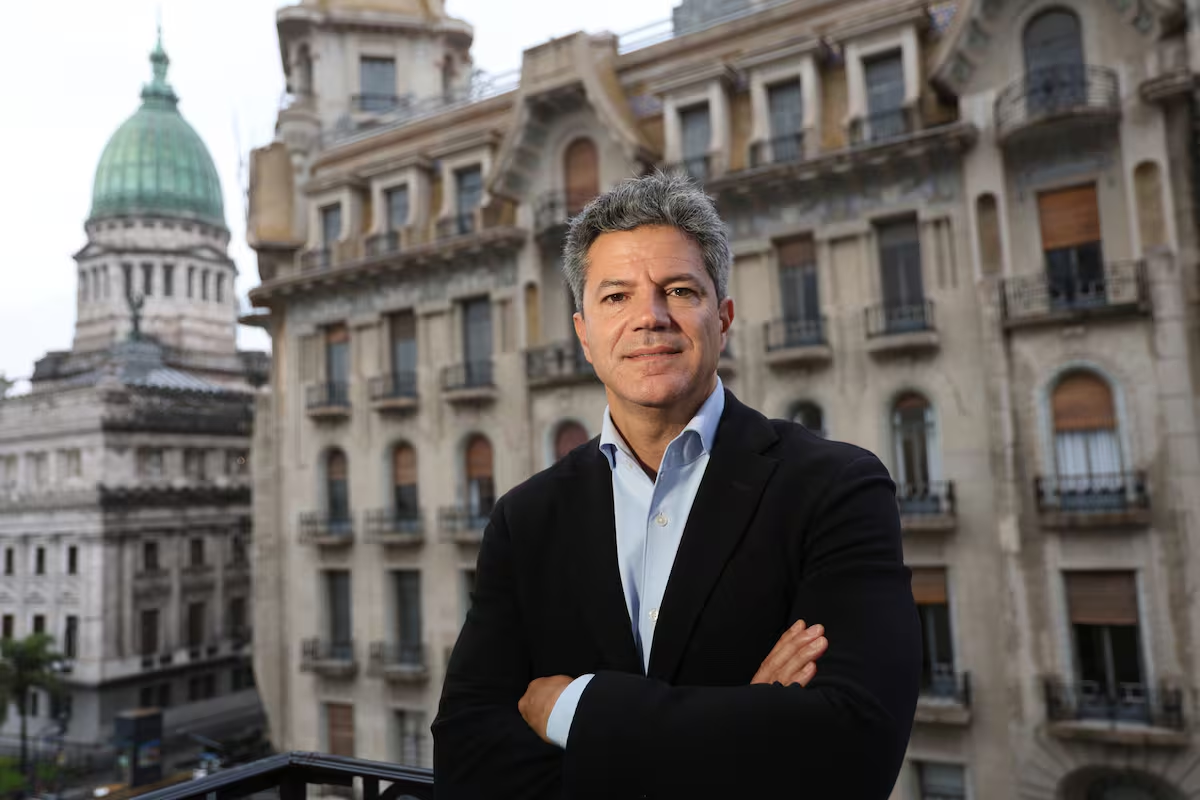
Luciano Laspina developed a career shaped by applied economics, financial management, and legislative debate. His profile combines technical training, executive experience at Banco Ciudad, a decade as a national deputy, and a new stage at the head of CIPPEC, where he works on public policy, institutional quality, and economic development.
An economist trained to intervene in public decisions
Luciano Laspina built a career positioned between economic analysis, financial administration, and institutional politics. Born in Rosario, he earned a degree in Economics from the National University of Rosario and later obtained a master’s degree in Economics from Universidad del CEMA. That technical foundation allowed him to participate in debates where fiscal data, budget rules, and the quality of public decision-making occupy a central place.
From economic theory to financial management
Before fully entering parliamentary activity, Laspina worked in roles linked to applied economics and institutional management. Between 2008 and 2015, he served as chief economist and CFO of Banco Ciudad de Buenos Aires. That position involved managing financial information, assessing risks, projecting scenarios, and organizing decisions with an impact on a relevant public institution. His profile was consolidated there as a technical figure with executive capacity.
Parliamentary leadership in the fiscal agenda
Laspina was a national deputy between 2015 and 2025, a period in which he held a visible position in Argentina’s congressional economic discussions. His presidency of the Budget and Finance Committee between 2015 and 2019 placed him in a key role for debating public spending, fiscal resources, financing, and taxes. That space requires political leadership, technical knowledge, and the ability to negotiate on issues that affect the state and the provinces.
A management vision applied to politics
Although he does not fit the classic profile of a corporate CEO, Laspina brought tools from executive leadership into public policy. His career shows a constant concern for efficiency, fiscal sustainability, and evaluation of results. In that approach, business vision appears as a method: analyzing limited resources, defining priorities, measuring impacts, and building institutional decisions with criteria of economic responsibility.
Budget, taxes, and institutional rules
His public influence became associated with issues such as the budget, tax reform, state spending, and fiscal rules. In those fields, leadership does not depend only on holding office, but on organizing complex problems and turning them into understandable discussions. Laspina developed a technical voice within a political system marked by recurring tensions between social demand, inflation, deficits, debt, and the need for sustained economic growth.
CIPPEC and a new stage of leadership
His arrival at the executive direction of CIPPEC opened a different stage in his career. From that role, Laspina moved from parliamentary representation to leading an organization dedicated to the design, analysis, and promotion of public policies. Directing a think tank requires coordinating technical teams, sustaining institutional independence, engaging with public and private actors, and transforming evidence into applicable proposals.
Intellectual production and formation of judgment
In addition to his work in management and politics, Laspina has also developed academic activity and intellectual production. He teaches at the Business School of Universidad Torcuato Di Tella and is the author of the book Desenredar la Argentina. Diagnósticos y propuestas para quebrar la decadencia. That dimension completes his profile: he does not only participate in short-term debates, but also seeks to organize diagnoses of Argentina’s structural economic problems.
Leadership based on data, diagnosis, and management
Luciano Laspina represents a type of economic leadership supported by technical training, executive experience, and institutional action. His influence does not come from running a private company, but from having occupied spaces where economic decisions are formulated, negotiated, and transformed into policies. His career shows one constant: organizing public problems through information, rules, planning, and management capacity.