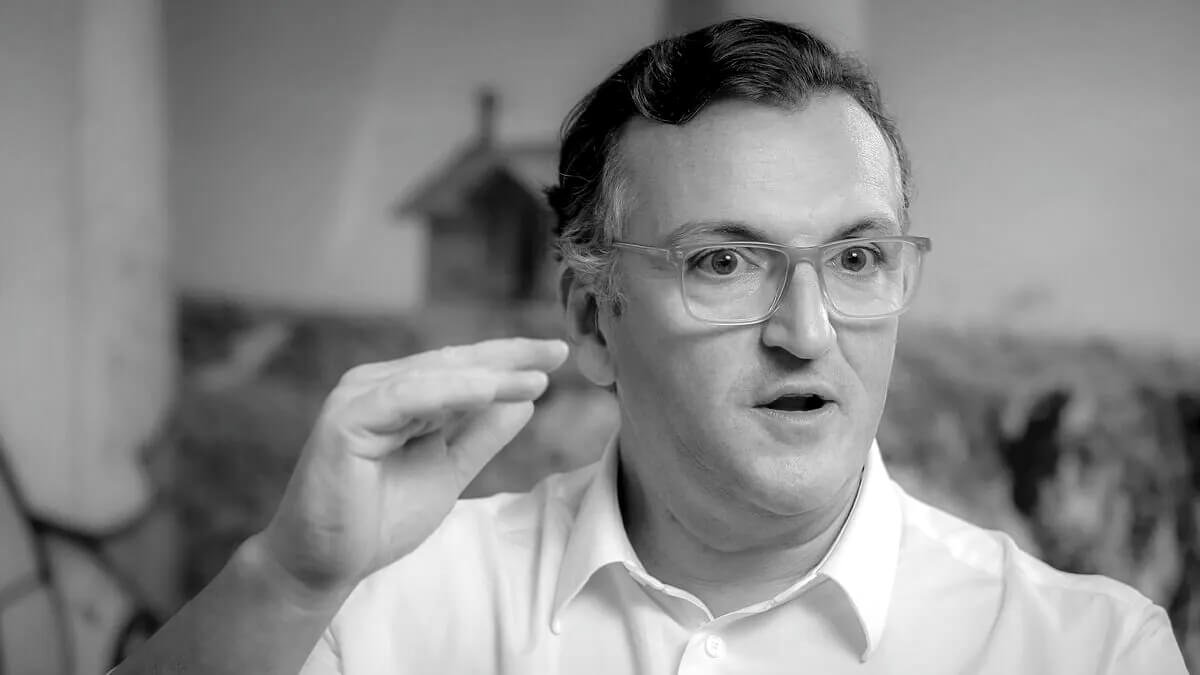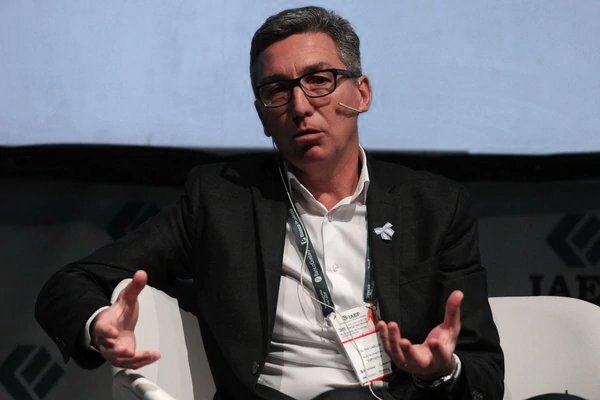
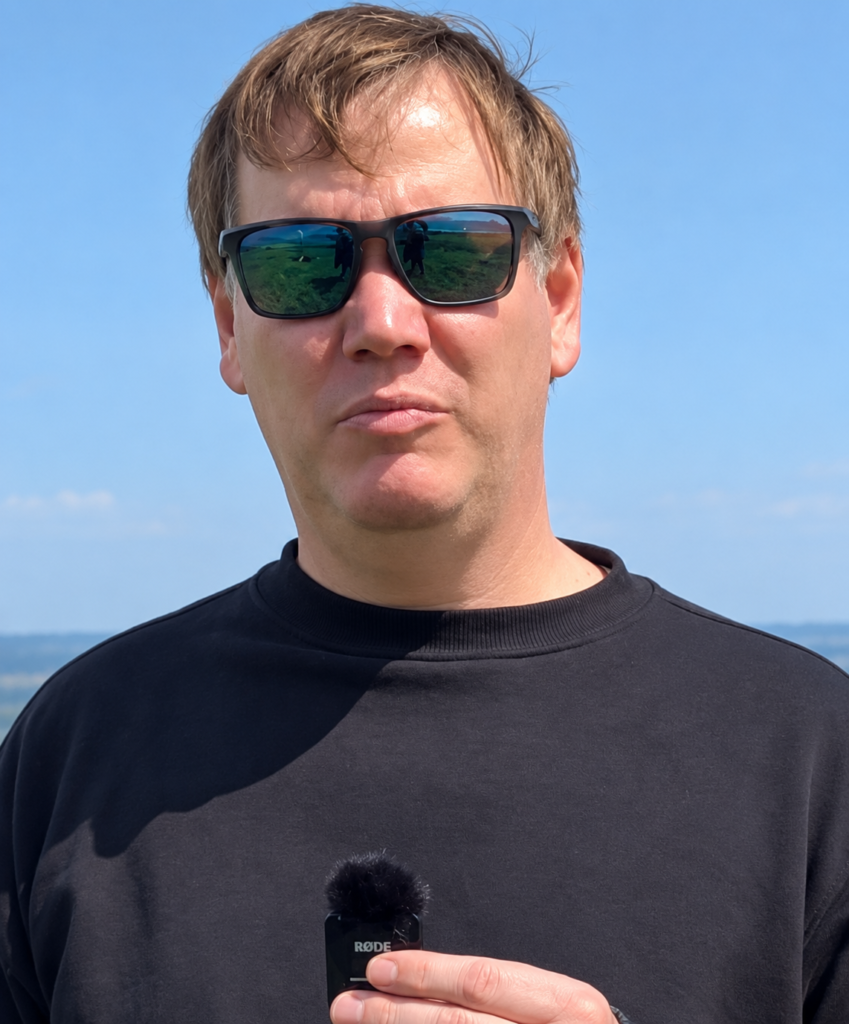
Fernando Genin
Until recently, the way to find out how much grass was available in a paddock was to cut it with scissors, dry it in a microwave and weigh it. Fernando Genin, a systems graduate and lecturer at the Faculty of Engineering of the National University of Mar del Plata, set out to replace that procedure with electronics, satellites and algorithms. The company he founded with two pasture specialists is called Pastech, operates in more than thirteen Argentine provinces and has expanded into Uruguay and Australia. In 2025, it won Bayer’s Legado award among 360 applicants from five countries, was chosen as Argentina’s top entrepreneurial venture by the national government from more than 800 candidates, and received recognition from Mar del Plata’s software industry, including a trip to Silicon Valley.
The scissors, the microwave and the scale
A cow eats around twenty kilograms of grass per day. If a producer does not know how much pasture is available, it is impossible to decide how many animals to place in each paddock, when to move them or how much purchased feed to add.
Until recently, the method for finding out was exactly as Genin describes it, without any irony: cut a sample with scissors, put it in a microwave to dry it and weigh it. Artisanal, slow and with a considerable margin of error.
The rest of the decision was made by eye.
Genin summarizes that starting point with a phrase he repeats in interviews: moving from “more or less” to objective data. And he makes clear that this is not a technical debate but an economic one, because stocking rates, supplementation costs and soil condition all depend on that estimate.
Three profiles that do not overlap
Pastech emerged from the intersection of two faculties at the National University of Mar del Plata that do not usually interact very much: Agricultural Sciences and Engineering.
Genin brings his background from the latter. He has a degree in systems, a master’s in business administration and teaches at the Faculty of Engineering, where he also supervises final projects by Computer Engineering students and participates in university hackathons. His role on the team is to provide the technological and digital-transformation perspective.
The other two come from agriculture.
Juan Insua is co-founder and international director of R&D and Technology. Alejandra Marino, co-founder and regional director of Business Development and Logistics, focuses on forage-resource production and logistics. Both are recognized specialists in pastures and animal nutrition in Argentina and the region, with experience at INTA Balcarce and at the university itself, as well as publications and research on forage management and livestock sustainability.
That combination helps explain the product. When Bayer explained why it selected them, it pointed to something that sounds obvious but is not always so in the world of agricultural applications: the team understands the problem from the inside and speaks the producer’s language.
Genin puts it in his own way. He says that every solution they develop begins with walking the fields and listening to producers.
Four tools, one platform
The first component is a portable electronic pasture meter that measures the compressed height of the grass in real time and translates it into available biomass. It is the direct replacement for the scissors.
The second is satellite-based: a system that estimates forage availability remotely, without anyone having to walk the field.
The third involves drones equipped with multispectral sensors for detailed inspection of a specific plot.
All of that feeds into a web platform with estimation algorithms and artificial intelligence, including a grazing module that combines pasture supply with the herd’s nutritional demand and indicates the optimal times for animals to enter and leave each paddock.
The result Genin cites is concrete and comes with two figures. He says it has been demonstrated that this kind of management can produce up to 750 additional liters of milk per cow per year and up to 200 extra kilograms of meat per hectare.
The other half of the argument is environmental. Better use of pasture means optimizing stocking rates, spending less on supplementation and avoiding overgrazing, which degrades the soil. Well-managed grassland also captures more carbon.
His summary: it is not just about measuring grass, but about turning that measurement into an economic management tool.
One year, three awards
2025 was the year Pastech stopped being merely a promising project.
In August came the Legado award, organized by Bayer Foundation, Bayer and Endeavor Uruguay. More than 360 ventures from Argentina, Bolivia, Chile, Paraguay and Uruguay applied. Pastech won. The justification highlighted proven impact, a disruptive proposal and the potential for global scale.
In September came the Emprendimiento Argentino competition organized by the national government, with more than 800 applicants at provincial stages, 46 finalists and a final round featuring twelve projects. Pastech won the Despegue Emprendedor category, aimed at ventures that had already validated their proposal and completed their first sale within the previous two years.
In November, at the closing of Mar del Plata Tech Week, the ATICMA Awards named it Innovative Venture of the Year. The program had received 150 projects, selected 18 and reached a four-project final. The prize included a trip to Silicon Valley.
About that recognition, Genin said something that captures how he sees the matter: it gave them an opportunity to show what they were doing from Mar del Plata, make contacts and attract investors.
Silicon Valley is not tourism
The trip took place in May 2026, and the company made a point of explaining that it did not see it as a reward.
The phrase they used was that Silicon Valley is not business tourism. Genin added a warning that is fairly unusual for someone who has just won three awards in a row: going there does not mean automatic success; it means exposing yourself to the highest standard of innovation and returning with a more ambitious idea of what the company could become.
International expansion, meanwhile, was already underway. Pastech opened an office in Uruguay, where it delivered four electronic pasture meters and worked with the Experimental Station of the Faculty of Agronomy in Paysandú on a project to redesign intensive milk-production systems. The trip included Colonia, Young, Paysandú and Montevideo.
It also began operating in Australia, a market where pasture-based livestock farming is a major industry and technological competition is considerably tougher than in the region.
What comes next, according to him
The goals Genin has put on the table are deliberately uncomfortable.
He has spoken about growing 146-fold in eighteen months, reaching 25% of the Argentine and Uruguayan markets, and entering Brazil and Paraguay.
And he emphasized the detail that makes him most proud: the technology is developed entirely in Mar del Plata, from research to electronics and software.
It is a local industry, he said, with global potential.
For a city that usually appears in the news because of tourism and fishing, and for a sector with a reputation for resisting change, there is something fitting about the idea: the startup that wants to digitize Argentine livestock farming was born in an engineering classroom six blocks from the sea.