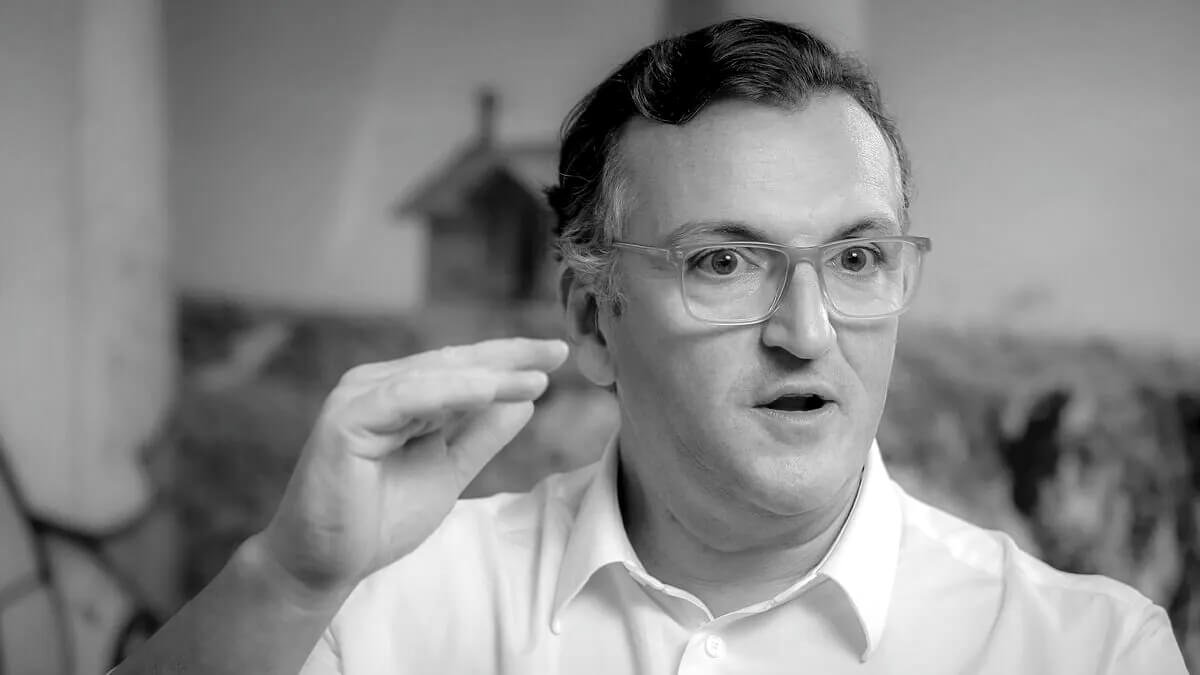
Alberto Arizu

Fourth generation at the helm of a winery founded in 1901, he led Argentine premium wine’s move onto the global stage and opened the family company’s capital to a fund connected to the world of luxury.
Few Argentine companies cross the century mark without changing hands. Luigi Bosca did, and an Arizu is still at the forefront. Alberto Arizu, great-grandson of the founder and fourth generation of the family, chairs the winery his great-grandfather launched in 1901 in Luján de Cuyo. From that position, he pushed something larger than selling bottles: turning a Mendoza label into a brand capable of competing as an equal in the global fine wine market.
From a Village in Navarre to Luján de Cuyo
The surname carries geography and craft. The Arizus came from Unzué, a hamlet near Pamplona where they already cultivated vines; on the other side of the family tree, the Boscas came from Piedmont, Italy, another land with a strong winemaking tradition. Leoncio Arizu, the Basque immigrant who crossed the Atlantic in the late nineteenth century, became attached to Mendoza and established the winery in 1901. His son Saturnino, already born in Argentina, added a more technical imprint in 1933, with selected genetic material for the vineyards. And in the 1960s, the current president’s father — also Alberto, an agronomist by training — entered the scene after returning from California with an idea that would reshape the Argentine wine shelf.
The Varietalism That Rewrote the Argentine Label
Until then, wine in Argentina was sold under borrowed names: Burgundy, Chablis, French appellations that guaranteed nothing about what was inside the bottle. The winery broke with that practice in the early 1970s, when it launched its first four varietals — Malbec, Cabernet Sauvignon, Chardonnay and Riesling — with the grape variety written on the front label. It was a risky move in a country that consumed liters of table wine without asking many questions. Arizu often recalls that Luigi Bosca was the country’s first boutique winery precisely because of that: it made quality wines when the local business was chasing volume. That DNA had a regional consequence: in 1989, Luján de Cuyo Malbec obtained the first Controlled Designation of Origin for Argentine wine, a European-style seal that, at the time, was well ahead of its era.
Alberto Arizu’s Move: Opening the Capital
In 2018, he made an unusual decision for an Argentine family company. He brought in L Catterton as a partner, the investment fund linked to the LVMH holding company and the Arnault family, one of the heavyweights in the luxury business, with more than US$25 billion in assets around the world. For Arizu, the move brought something more valuable than fresh capital: contacts, markets and proven experience in building global brands. He frames that opening within a broader criticism. Argentina, he argues, is “a country disconnected from the business world,” with eight out of ten companies privately held, while abroad the proportion is reversed. Opening the shareholding structure, in his view, is one of the lessons much of the local economy still needs to learn in order to play abroad.
Cabernet and the Fight for the Large Segment
Malbec put Argentina on the map, and Arizu does not dispute that. But he works with a cold piece of data: that variety accounts for barely 3% of global consumption, while Cabernet Sauvignon is around 20%. A brand that aspires to stand alongside the major players needs to enter that broader field. That is why the winery accelerated its Cabernet project and hired Robert Mann, the Australian winemaker nicknamed “Mr. Cabernet Sauvignon” because of his work at top-level wineries in Australia and California. The benchmark it set is high: Argentine Cabernet competes head-to-head with Bordeaux and California, two cathedrals of that grape.
The CEO Who Learned to Measure Wine in Flight Hours
Beyond the vineyard, Arizu holds a degree in Business Administration from the National University of Cuyo, with postgraduate studies in strategic marketing in San Diego and executive development at Austral. He literally walked the commercial side of the business: over a decade, he visited more than fifty countries promoting Argentine wine, and he went on to chair Wines of Argentina, the organization that brings together exporting wineries. From his father, he inherited a way of thinking about the craft that he likes to repeat: understanding wine is similar to flying an airplane; everything is a matter of accumulating hours, tasting and tasting again. He runs marathons — as an amateur, he clarifies — has skied since childhood and has five children.
Meanwhile, the old El Paraíso estate, where three generations of the family lived, is preparing to reopen as a space for wine experiences, and a blend bearing the same name already carries that legacy into the bottle. The bigger fight — Cabernet and the markets of the United States, Canada, England, China and Brazil — is only just beginning.