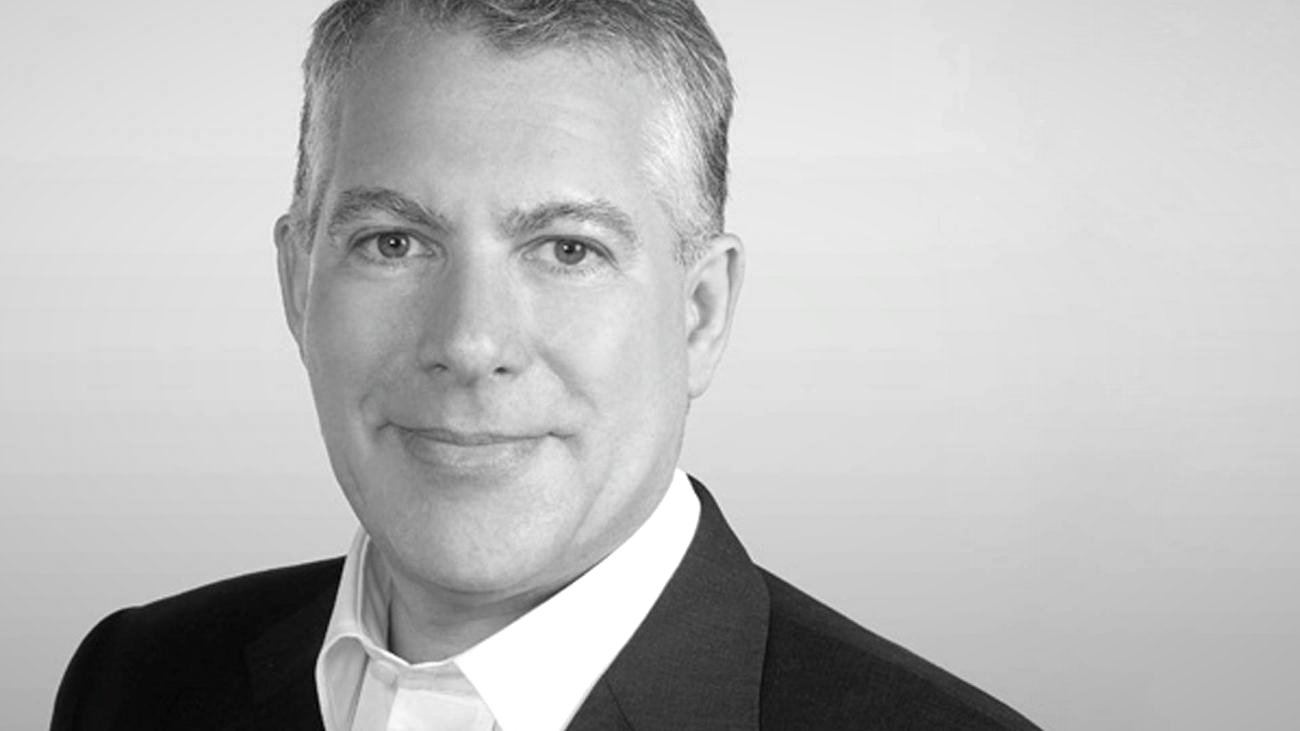
Gerardo Bartolomé
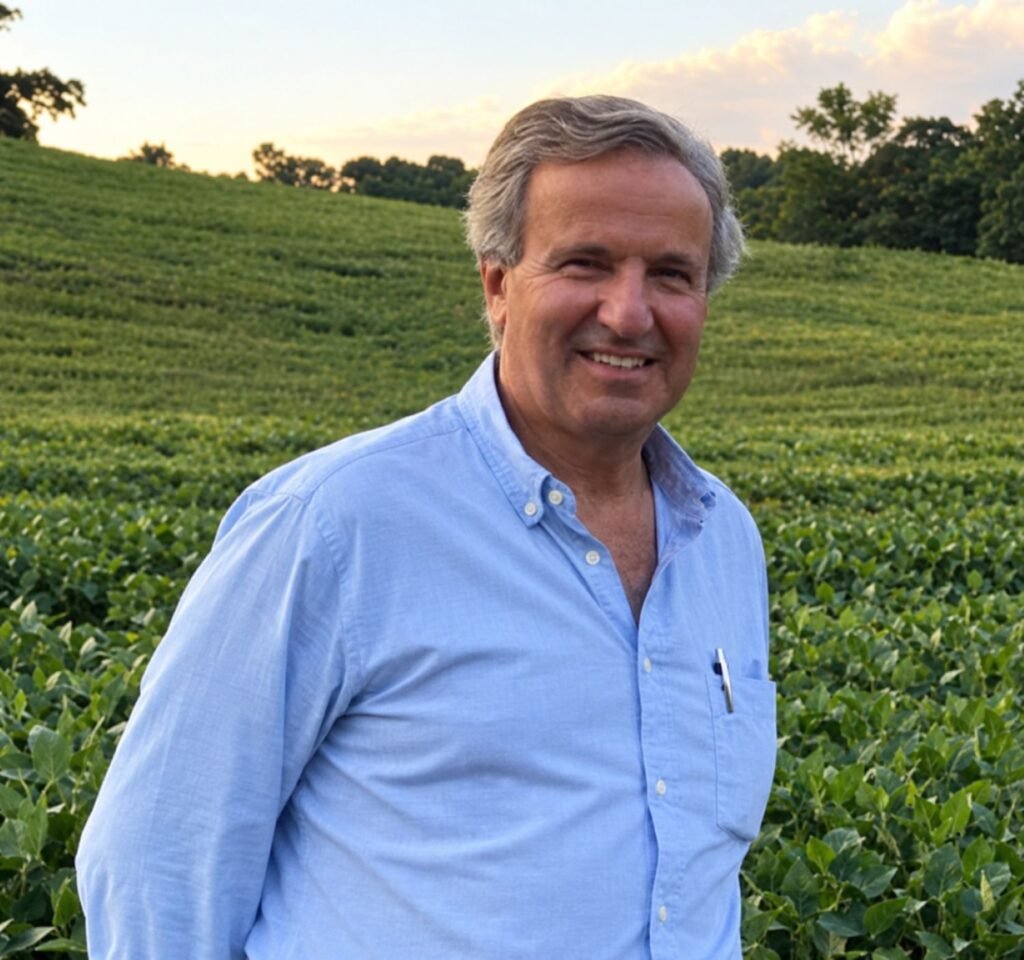
He began in 1982 with a fifty-hectare soybean trial in Chacabuco, on land lent to him by a partner’s mother. Four decades later, the company he founded has its genetics in 79% of the soybean seed sold in Brazil, operates in more than fifteen countries and has just bought a U.S. seed company to enter the ranks of the world’s four largest corn players. In January 2022, he handed leadership over to his son.
Fifty Borrowed Hectares
There is nothing epic about the starting point. In 1982, a group of young agronomists set up a soybean trial covering around fifty hectares in Chacabuco. The land was lent by the mother of one of them, César Belloso.
Bartolomé remembers it as an experiment that was more academic than commercial. It went well enough for him to replace his car, which, at that age and in that context, was the available measure of success.
What drew them to the crop, according to him, was precisely what remained unknown. At the time, soybeans presented an enormous number of unresolved agronomic questions, and that uncharted territory ultimately shaped his career.
The company’s name came from home: Mario was his brother Alejandro’s nickname, taken from his middle name.
The Diagnosis That Founded the Company
In the mid-to-late eighties, Argentine farmers had very few soybean varieties to choose from. Almost everything available came from abroad and was suited to conditions different from those in the country.
The founders decided to develop an Argentine soybean seed. And their first technical move explains much of what followed: they introduced shorter-cycle maturity group IV varieties, which were better adapted to Argentina than the group V varieties then commonly used.
They registered their first variety in 1988. In the mid-nineties, they began their own trials. Later, they became the first to launch a glyphosate-resistant group IV variety, at the precise moment when that technological package was reshaping agriculture across the region.
For a leadership website, the point to emphasize is the nature of the bet. They chose not to compete on scale or price against enormous multinationals, but on local adaptation: making the seed suited to this soil and this climate, which was exactly what global companies were not doing.
From Chacabuco to Brazil
International expansion began around two decades ago and started close to home, in Uruguay. From 2003 onward, they added Brazil, Bolivia and Paraguay.
Brazil was the biggest prize, because it is the world’s leading soybean producer, and also the toughest test. They entered in 2003 and did not launch their first product until 2008. Five years of investment before selling anything.
The subsequent trajectory explains why the wait was worthwhile. They started with a 6% market share in the first year. They reached 64% in 2021. And by 2023, their genetics were present in 79% of the soybean seed sold in that country.
An Argentine fact that often goes unnoticed: the country that competes with Brazil in the soybean market sells Brazil the genetics with which Brazil produces soybeans.
In the United States, they began research in 2008, with a modest initial target of around 5% of the market. Today, that country contributes between 17% and 18% of the group’s revenue, while Brazil accounts for around 70% and Argentina approximately 12%.
A Company That Is Half Laboratory
GDM’s internal structure says a great deal about how Bartolomé understood the business: approximately half of its staff work in research.
The most telling indicator of that investment is time. The cycle from crossing two plants to commercially launching a variety fell from eleven years to six. In a business where the competitive advantage is genetic, halving the cycle means doubling the number of possible attempts.
The challenge the company itself identifies is the shift from traditional breeding toward a predictive approach, using artificial intelligence and automated genotyping. It is the same move pharmaceutical companies are making, applied to plants.
Recent developments point in that direction. They created the first gene-edited soybean with low sugar content and a more drought-tolerant variety. The regulatory detail matters: authorities in Brazil, Argentina and Colombia consider those edits equivalent to conventional soybeans, avoiding the costs and approval timelines of a transgenic crop.
When Bartolomé is asked what he attributes the growth to, his answer does not change: investment in research and the team’s passion for soybean breeding.
Buying in Indiana
The company’s current stage shows a reversal of the historical flow. First, they bought KWS’s corn and sorghum assets in South America. Then, in June 2025, they announced the acquisition of AgReliant Genetics, a seed company based in Westfield, Indiana, founded in 2000 as a joint venture between Europe’s KWS and Limagrain.
AgReliant has one of the largest temperate corn germplasm banks in the hemisphere and operates the AgriGold, LG Seeds and PRIDE Seeds brands. With that purchase, GDM would become the world’s fourth-largest supplier of corn genetics.
A company born in Chacabuco buying a U.S. seed company owned by two European giants. In the history of Argentine business, it is an unusual move.
The Least-Told Chapter
On January 1, 2022, Ignacio Bartolomé became GDM’s CEO. He is Gerardo’s son, who learned the fundamentals of the business from his father as a child and with whom, according to Ignacio himself, he jointly decided that the time had come for the handover.
It is worth pausing here, because succession is where many family businesses break apart. A founder who has spent forty years building something often has a structural difficulty letting go, and handing it to a child adds layers of conflict that fill management libraries.
In this case, the handover took place while the company was expanding, rather than during a crisis that forced change. And the period afterward saw the greatest acquisition activity in its history.
One contextual detail makes the decision more interesting: the business was entering its greatest phase of technical transformation since its founding, with artificial intelligence applied to breeding. Handing over leadership just before that leap, rather than afterward, reflects a fairly precise understanding of one’s own limitations.
What His Story Offers as a Leadership Case
Bartolomé’s career provides a counterexample to several beliefs in the entrepreneurial world.
He did not start with venture capital or a disruptive idea, but with an agronomic trial on borrowed land. He did not choose a large market, but a specific problem multinationals were not addressing. He did not seek visibility: GDM remains one of the least-known Argentine companies relative to its global importance. And he did not compete on price, but on a technical advantage that requires decades of accumulation and is very difficult to copy.
The final decision, handing over control while everything was going well, is the one for which he receives the least recognition and probably the one that says the most about his way of leading.