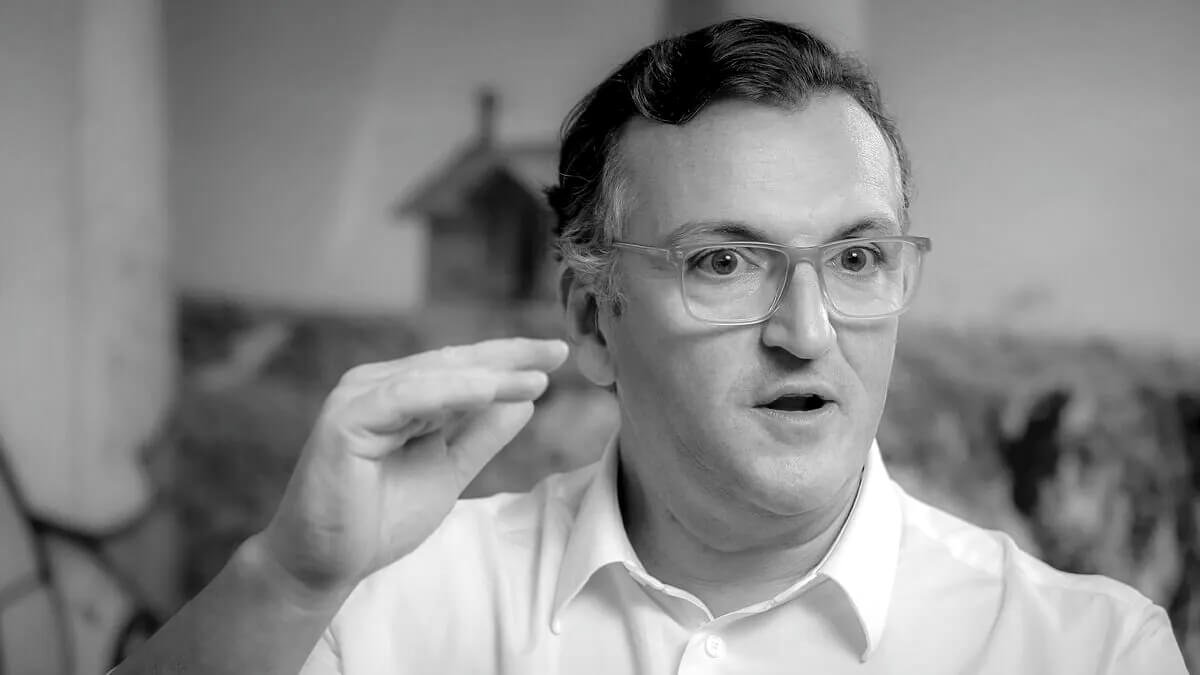
Eduardo Bastitta

Eduardo Bastitta failed twice before turning thirty. A beverage delivery business could not withstand informal competition, and an agricultural investment pool ran out of steam during Argentina’s farm conflict. From that frustration came a conclusion that changed his career: he needed a real-asset business capable of surviving the cycles of the Argentine economy. He found it by looking at warehouses along the highway in the northern Greater Buenos Aires area. That is how Plaza Logística was born, the company that introduced sustainable logistics parks to the country and that he led for fourteen years. Today, he heads a much more ambitious project: building an entire city on the Uruguayan coast.
A Poor Student With Two Vocations
Bastitta graduated from Cardenal Newman with no intention of continuing his studies. He had done poorly at school and already considered finishing high school an achievement. Even so, he eventually enrolled in Business Economics at Universidad Torcuato Di Tella.
He identifies two drives he has carried since he was thirteen: entrepreneurship and, in his own words, planting the seeds of change in the country, an obsession he attributes to his mother’s influence. That duality explains many of his later decisions.
He began starting businesses before graduating. His first project was a website where he uploaded photos taken at nightclubs, an idea ahead of its time in an era before smartphones. It attracted significant traffic until the collapse of the dot-com bubble cut off its funding. His next venture took him to southeastern Buenos Aires Province and into high-oleic sunflower farming. After that came his only two experiences as an employee: Tecnonexo and Quilmes brewery.
Capone and the Most Expensive Lesson
While working at the brewery, he created Capone, one of Argentina’s first beverage and snack delivery services. The project grew so much that in 2006 he quit his job to focus on it full time.
The ending was bitter. Competitors appeared offering the same service without paying taxes, and the numbers stopped working. Bastitta remembers the closure as a major frustration, not because the idea was wrong, but because the business could not withstand informality. That experience, he says, was destructive precisely because of the absence of clear rules. He often summarizes his career with a phrase: he founded some companies and bankrupted others.
Love at First Sight With a Warehouse
In 2008, still shaken by the experience, he considered moving to the United States. A conversation with his American friend Benjamin Griswold convinced him to stay and start something different together: long-term investments that could outlast economic cycles. From that came the principle that would define the company: innovation through real assets.
They analyzed farmland and office buildings until, during a trip through northern Greater Buenos Aires, Bastitta came across warehouses. He describes it as love at first sight and says he became obsessed with the idea of entering the heart of his future clients’ logistics operations and transforming them.
Plaza Logística was founded in 2009 around a central idea: multi-tenant logistics parks where several companies share infrastructure, technology, and services, creating synergies and reducing costs. It began with the purchase of a plot of land where they built the first park.
Warehouses for the E-Commerce Era
The model benefited from a profound change in consumption. Bastitta explains that the business shifted from distribution centers shipping pallets of a single product to far more granular operations that must deliver one individual item to a specific home.
That requires different facilities: next-generation warehouses with very high ceilings, temperature control, and strong, perfectly level floors that allow denser and faster operations. The company eventually operated six parks, three in northern Greater Buenos Aires, two in the south, and one in the City of Buenos Aires, including the enormous distribution center it developed for Mercado Libre.
Building With Environmental Certification
Sustainability became one of the company’s defining characteristics. Plaza Logística uses LEED and EDGE standards in the construction of its parks, the latter an efficiency certification granted by the International Finance Corporation, and manages its operations under ISO 9001 for quality, ISO 14001 for environmental management, and ISO 45001 for occupational health and safety.
It also introduced LED lighting throughout several sites and ecological islands, implemented since 2013, where clients centralize the management of recyclable waste such as cardboard and plastic film.
In 2021, the company took a step that made it a landmark case in Argentina’s capital markets. It issued 1.8 billion pesos in UVA-indexed debt with a 42-month maturity and became the first private Argentine company to issue a bond classified simultaneously as sustainable, green, and social, receiving the highest possible rating from an agency affiliated with Fitch Ratings. The funds were allocated to environmentally certified developments and job creation focused on young people and women in the emerging e-commerce logistics sector.
Bastitta said at the time that he was proud to break new ground in sustainability from an industry that, in his view, has much to contribute both to reducing environmental impact and improving social conditions.
Financing Through Difficult Years
One of the keys to his management was securing long-term capital in a country where it is scarce. Between 2009 and 2014, the company financed itself through loans from multilateral organizations such as the Inter-American Development Bank and the U.S. development finance agency. From 2016 onward, it began replacing those sources with local alternatives that offered longer maturities and better conditions, and later added two debt issues, one in dollars and another in UVA-adjusted pesos.
The company invested around $200 million in developing four logistics parks in Greater Buenos Aires, another $60 million in 2019 to expand four sites, and more than $350 million over a three-year period. In 2023, it announced an investment of more than $80 million to build an additional 118,000 square meters and its first urban last-mile warehouse beneath a highway concession in the City of Buenos Aires. That same year, Euromoney named it the best logistics developer in Latin America’s real estate market.
The Transition and a New City
In August 2023, Plaza Logística appointed a CEO for the first time since its founding. The choice was Ramiro Molina, CFO since 2014, with the goal of increasing leasable space by 50% over five years. Bastitta, who had led the company for fourteen years, moved to the board, where he continues to contribute to its strategic direction.
His energy is now focused on +Colonia, a 515-hectare urban development on Uruguay’s coast, around fifty minutes from Buenos Aires by ferry, built on land his father, Carlos Bastitta, purchased almost four decades ago. The project began with an initial investment of $100 million and aims to double the population of Colonia del Sacramento, a city that has remained at around 30,000 residents for roughly sixty years.
Bastitta describes it as a city for entrepreneurs and rejects comparisons with a gated community: he talks instead about creating a community. His “two shores” concept proposes that residents combine Uruguay’s tax advantages and mortgage credit with proximity to Buenos Aires’ cultural offerings. The first 400 residential units are scheduled for delivery between 2026 and 2027, and a school is planned for families who settle there. In September 2026, the project added the Praxis technology community, led by American entrepreneur Dryden Brown, which announced an investment of more than $1 billion to begin establishing itself there in 2027.
A Businessman With Strong Views
Bastitta is an Endeavor entrepreneur, served on an advisory council to President Javier Milei, and has repeatedly argued for clear rules that allow formal businesses to compete, an idea he has carried since the failure of Capone. His assessment of Argentina is critical and expressed directly: he finds it frustrating to live in a country that, in his view, fails to provide dignity to most of its people.
The two vocations he identified at thirteen still coexist. First came concrete, steel, and environmental certifications. Now, quite literally, an entire city from scratch.