Agustina Besada
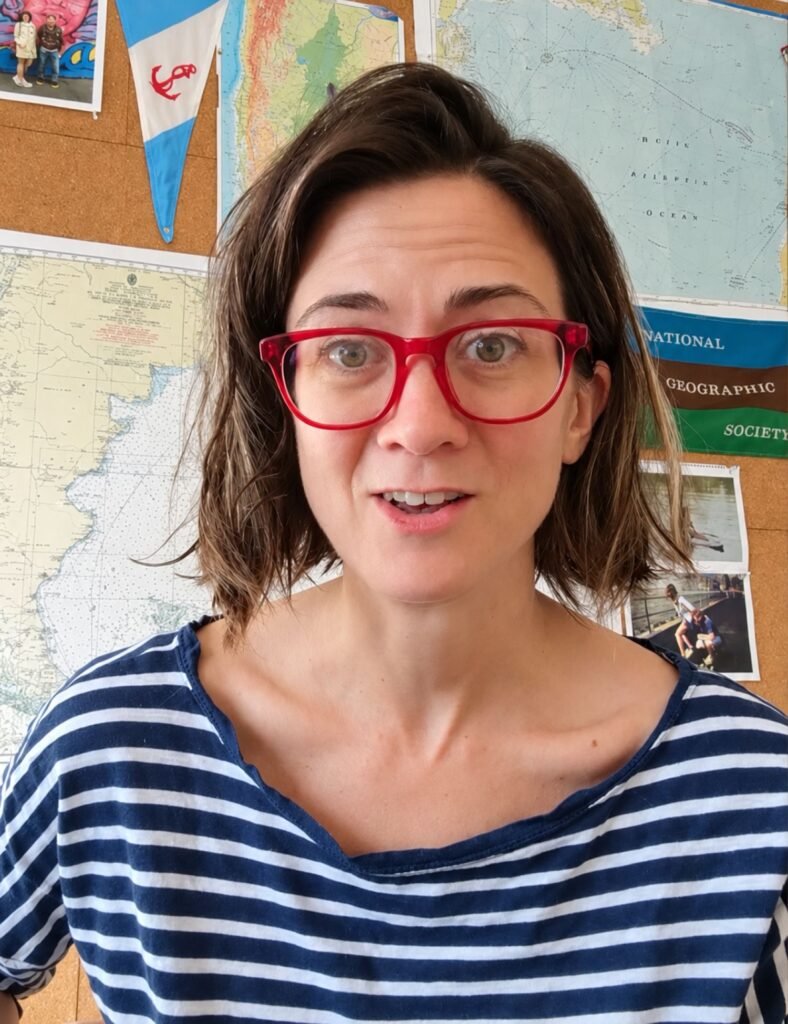
At seven, she persuaded her building’s superintendent and neighbors to separate recyclables. Three decades later, she runs a social enterprise that measures the plastic footprint of entire companies and achieved a 90% reduction rate with a fast-food chain. In between, she left medical school, trained in industrial design and sustainability management, ran a recycling center in Brooklyn and crossed the Atlantic twice in an eleven-meter sailboat, collecting ocean samples.
Her First Project Was at Seven
The scene is an apartment building and a seven-year-old girl negotiating with the superintendent to have recyclable materials separated. She persuaded the neighbors, too. It was her first experience managing a system, even if no one would have called it that.
She grew up in an upper-middle-class family and spent summers in the countryside in the south of the country. At thirteen, she joined an extracurricular activity supporting rural education in northern Argentina, which in her biography serves as a second example of the same impulse: getting involved in other people’s problems with the intention of solving them.
The detour came later. She began studying medicine, more through family influence than personal vocation, and left after a trip to Patagonia. That trip reordered her interests and led her to industrial design, a discipline that seems far removed from environmental activism but explains a great deal in her case: industrial design teaches people to think about how an object is manufactured, which materials it uses and what happens to it when it is discarded.
Brooklyn, 400 Collectors and an Uncomfortable Conclusion
She then trained in sustainability in Barcelona and later completed a master’s in Sustainability Management at Columbia’s Earth Institute, as well as an executive program at the university’s business school, where she also worked at its center for operational excellence. That combination—design, management and the scientific method—defines how she works today.
In New York, she began volunteering at Sure We Can, a community recycling center in Brooklyn. She joined the board and eventually became its director. The center provides work for around 400 urban collectors, who process an average of approximately 40,000 aluminum cans and plastic bottles each day.
There, in a place where recycling works well, she reached the conclusion that would later shape her entire career: recycling is not enough. However efficient the recovery system may be, the volume of plastic being produced overwhelms it. The solution comes earlier, in not generating it.
It is an uncomfortable conclusion for someone who was running a recycling center, and it is exactly the kind of decision that distinguishes a manager from an activist: changing strategy when the data contradict the operation itself.
Seven Months of Data in the Middle of the Atlantic
In 2018, she did something few organizational directors would do: she boarded a sailboat and went to gather the data herself.
She sailed on the Fanky, a 37-foot vessel, from New York to Portugal, stopping in Bermuda and the Azores. She then continued through Europe. She crossed the Atlantic twice and, according to her Ashoka profile, the entire journey lasted around seven months. She did so as a National Geographic Explorer.
The part relevant to leadership is not the adventure; it is the method. Before leaving, she designed a framework: an interview protocol and criteria for collecting and analyzing data. She collected ocean plastic samples for the 5 Gyres Institute, interviewed European specialists, wrote about the journey and answered questions from the public aboard the boat.
Her way of summarizing what she learned at Columbia is almost a management principle: measure and quantify the problem before acting.
Unplastify took shape during those months.
How to Run an Organization That Sells What Cannot Be Seen
The business she built has a communication problem she herself acknowledges: it is difficult to show the impact of plastic that was not used. There is no photograph of the bottle that was never manufactured. Even so, she considers it the most effective path and defends it with an idea borrowed from the waste sector: the best waste is the waste that is never generated.
The response to that problem was to build measurement tools. Unplastify developed a methodology for calculating an organization’s plastic footprint, which can be applied to the entire company, a product line or only its internal operations. This allows companies to be compared, priority areas to be identified and a reduction strategy to be developed with the people inside the organization.
The corporate program has four stages: assessment, co-creation, implementation and measurement. Its strongest documented result was with a fast-food chain, where they achieved a 90% deplastification rate.
The word she uses to describe the objective is not awareness. It is systemic change. Her criticism of the usual approach is direct: she argues that reuse, recycling and circular economy models, on their own, do not solve the plastic problem.
Teenagers Who Design Their Own Projects
The educational program, which has operated since 2019, follows the same logic of delegating rather than preaching.
They work with fifteen- and sixteen-year-olds, and what they do is not give them a talk: they guide them in designing and implementing their own plastic reduction projects at school, in their neighborhoods and within their families. At the time of her selection as an Ashoka Fellow in 2022, the program had operated in nine institutions, including one in the United States and another in Mexico, reaching around 2,000 students directly and 17,000 indirectly. The stated ambition is a network of more than 500 schools across the region.
The underlying idea is for organizations to drive solutions rather than depend on an outside expert. For an impact consultancy, it is a model that deliberately gives up becoming indispensable.
From School to Legislation
The third front is public policy, and there are concrete results there, too.
In 2019, she advised then-legislator Brenda Austin on a bill to progressively ban certain single-use plastics. In 2020, she created argentinanodescarta.org, a platform through which twenty-five municipalities now have regulations in force on the subject. The approach includes measuring a regulation’s potential impact before promoting it and designing participatory processes for what they call a just transition.
Added to that is the annual “Plastic-Free July” campaign, a twenty-one-day challenge adapted from the global Plastic-Free July initiative, in which each participant chooses one single-use plastic and eliminates it.
In 2022, Ashoka selected her as a fellow, with a fellowship funded by IKEA Social Entrepreneurship through the Dela program. Before that, she had given a TEDx talk at Columbia with a title that summarizes her diagnosis: the plastic elephant in the room.
Leadership as Systems Design
Viewed as a whole, her trajectory is not that of an activist who became a professional, but of someone who applied management tools to a problem almost always approached through indignation.
The decisions that define her are all of that kind. She left medicine for industrial design, which gave her the language of materials. She ran a recycling center and concluded that recycling was not the answer. She went to the ocean to gather primary data rather than cite other people’s findings. And she built a measurement methodology to sell something intangible.
The target she set for the corporate side is ten thousand metric tons of plastic avoided. It is the kind of number a social enterprise needs to exist: verifiable, comparable and large enough to be worth discussing.